

Official Rules OF PLAY
1. PLAYING AREA
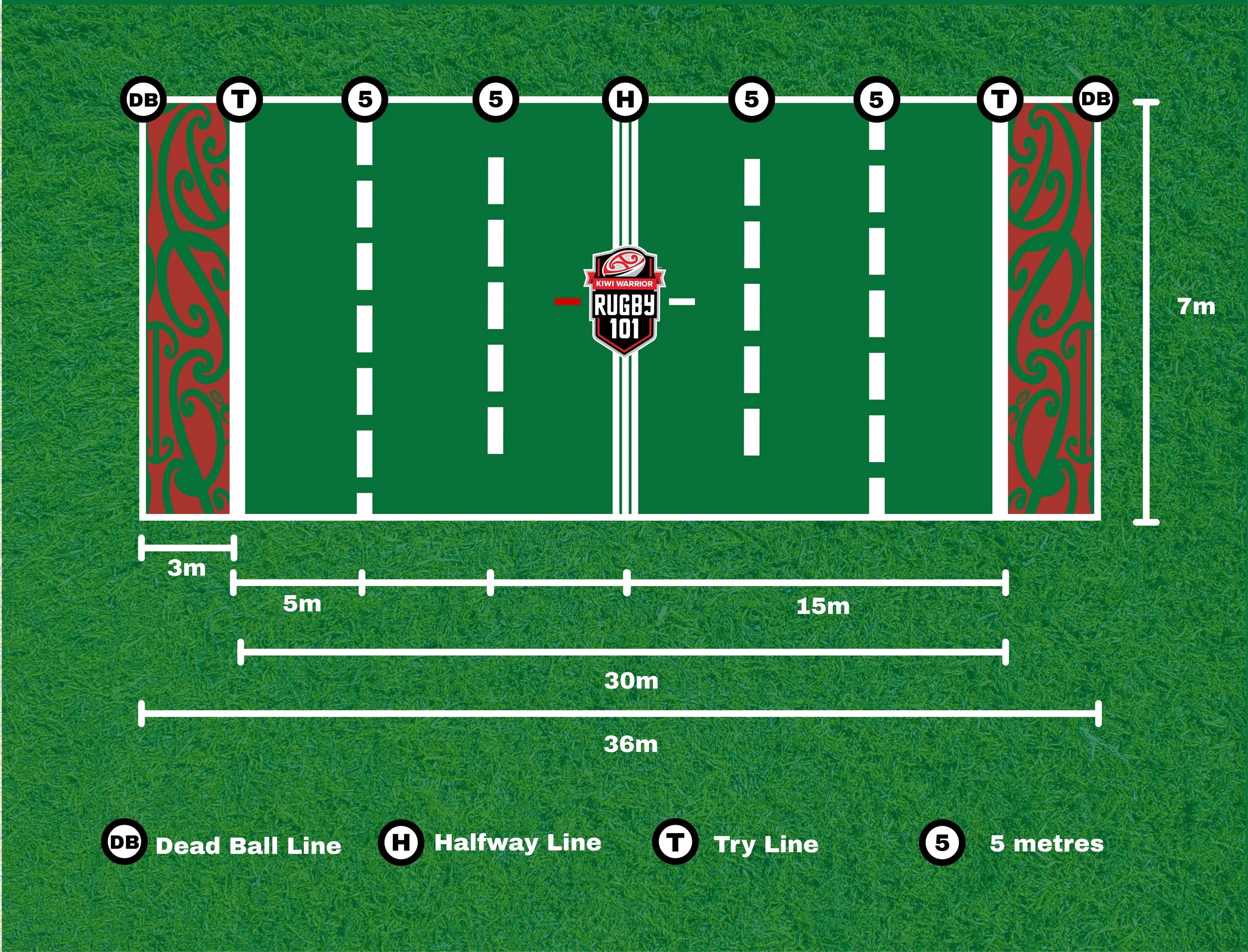
1.1 The playing area will ideally be up to 36 metres in length and 7 metres in width. Smaller or bigger fields can be organised depending on the competitions and tournaments.
1.2 For example, smaller playing fields can be approximately 26 metres in length and 7 metres in width, for younger age divisions.
1.3 The playing area will be marked by lines, flags or cones. If posts are used, they will have pads installed for protection.
1.4 Players and the referee will be the only people permitted on the field during play. Coaches, managers, and spectators must not be in the playing area during game time.
1.5 Rugby101 can be played anywhere, indoors or outdoors, on grass or artificial turf and sometimes on well-padded areas.
2. DURATION OF PLAY
2.1 It varies from games, competitions, and tournaments. A game is generally made up of two 5-minute halves, 10-minutes in total with 1 minute break at half time. It could also be played as a round format for example 4 rounds are made up of 5 minutes per round with 2 minutes break between rounds.
2.2 Younger age divisions will play two 5-minute halves, 10 minutes in total with 1 minute break between halves or 4 rounds made up of 5 minutes per round with 2 minutes break between rounds.
2.3 After half time players switch sides. If it’s a 4 rounds game, change in every round.
2.4 A game can only end on the full time.
2.5 A game will end immediately if a player is injured and unable to continue, or if the referee or match official determines that the game should be stopped. Where the injury occurs during fair play and no foul play is involved, the uninjured player will be declared the winner, regardless of the score at the time the game is stopped.
2.6 If a penalty is awarded at the end of the first half, final round, or full-time, the player is permitted to take the penalty conversion. If successful, the points will be awarded in accordance with the scoring system below.
3. NUMBER OF PLAYERS
3.1 The game is strictly 1 vs 1.
3.2 Except in the case of injury, every player must play at least two halves or four rounds of each game.
4. SUBSTITUTES
4.1 No substitutes allowed.
5. REFEREES
5.1 Where available there would be a referee appointed to officiate the game.
5.2 The referee will have a whistle.
5.3 The referee will call all plays and explain all rules breached.
5.4 The referee will keep time and stop at halves or round completion.
5.5 The referee will signal or blow the whistle if there is foul play.
5.6 The referee will make sure the defender gets back five metres.
5.7 The referee will call ‘play’ to commence the game.
5.8 if possible two linesmen will be present during the game to assist the referee. However, linesmen are not necessary.
6. THE POINTS
6.1 Try score = 7 points.
6.2 Try Conversion = 3 points.
6.3 Penalty = 5 points.
6.4 Goal drop kick = 3 points.
7. ATTACKER OR BALL CARRIER
7.1 The ball carrier can fend off (open hand fend not a punch or closed hand fist) the defender using their hands, body charge, run straight at, run around, run through, spin or side step the defender to advance toward the try line. Any carry cannot endanger the defender. For example, leading with an elbow to the head of the defender, kneeing, punch etc… (see foul play).
7.2 The ball carrier can guard or shield the ball with his hands, arms and body.
7.3 The ball carrier can chip or kick and chase the ball over the defender after tapping the third and final play.
7.4 The ball carrier may be awarded a penalty if the defender fails to retreat the required five metres. The ball carrier will be awarded five metres of territory or a conversion, at the referee’s discretion.
7.5 If a 5-metre penalty is awarded, the ball carrier may continue the attack from the 5-metre mark by referee with whatever number of plays remain in the current set. The penalty does not reset the number of plays.
7.6 The ball carrier can drop-goal on the third and final play to gain 3 points.
7.7 The ball carrier must tap the ball before running. The ball carrier must tap the ball on the third and final before drop-goal.
7.8 The ball must be tapped with the foot, either while held in the hand or placed on the ground.
7.9 The ball carrier may only kick on the third and final play. The kick may be a chip-and-chase, grubber, or kick over the defender. If the ball carrier regains possession, the set is restarted, unless the kick results in a try.
7.10 The referee will call play to start.
8. DEFENDER
8.1 The defender can tackle the ball carrier with a two-arm wrap-around tackle and bring the player down safely. No shoulder charges, no hip drops.
8.2 The defender can rip the ball off the ball carrier, stopping the ball carrier’s progress. A rip is only allowed if both players are still on their feet.
8.3 The defender can hold down the ball carrier for three seconds, roll away or get up and retreat 5 metres. The ball carrier can try and free themselves from the defender.
8.4 The defender must make all efforts to retreat five metres before the ball carrier restarts his play or referee calls a penalty.
8.5 High tackle is from the shoulder line upwards and is not allowed even if the tackle started from below the shoulder line.
8.6 Defender cannot use the back of the collar to tackle. Nor pull hair.
8.7 The defender needs to stop the attacker from scoring tries.
8.8 The defender has to retreat five metres after making a tackle.
8.9 The defender cannot move forward until after the ball carrier has tapped the ball.
8.10 If the ball carrier is tackled and pushed out or touches the sideline - it is a hand-over and the defender can now become the ball carrier.
8.11 At kick-off, the defender may advance as soon as the ball is kicked.
9. STARTING PLAY
9.1 Two Types of starting Play,
Kicking - The defender starts each half or round of the match from the centre of the field with a punt kick or drop-kick.
Taping - The attacker must tap the ball before running.
9.2 Kick to start, the ball must travel in a forward direction, directed to the ball carrier at no less than 5 metres.
9.3 Should the starting kick not make 5 metres or when kicked out on the full, it is an advantage ball and the ball carrier starts 3 plays from halfway.
9.4 If the starting kick went over the 5 metre line and was directed to the receiver where it landed inside and rolled out of the touchline, it would be a handover ball. (ie if the kick bounces out the kicker or defender will become the ball carrier)
9.5 The ball carrier can kick-tap to start three plays.
9.6 When a try is scored, the ball carrier that scored the try becomes a defender after the conversion kick and starts at halfway with a punt kick or drop kick to restart the game. ie The try scorer kicks off from halfway to restart the game.
10. Stripping the ball
10.1 The defender can rip the ball off the ball carrier only while both players are on their feet and until the ball carrier hits the ground.
10.2 If the ball is ripped from the ball carrier, the new ball carrier may run towards the try line and score a try, unless they are held or tackled.
10.3 If the new ball carrier is held and both players stop or go to the ground, the new defender must retreat five metres before the ball carrier can start three plays.
10.4 If the defender is unable to rip the ball from the ball carrier and both players go to ground, the ball carrier may retain possession and continue with the remainder of the set.
11. KNOCK ON AND KNOCK FORWARD
11.1 When a player knocks the ball in a forward direction or a sideway front motion and does not regain control of the ball before it touches the ground, it is a handover.
12. OFFSIDE
12.1 Offside occurs when the defender is not back 5 metres at kick-offs.
12.2 Offside occurs when the defender is not back 5 metres during play.
12.3 Failure to get back 5 metres will result in the ball carrier receiving a penalty. The play count will continue after a penalty is awarded.
13. PLAY ON
13.1 The referee will call play if they feel there is an advantage to either opponents.
14. KICKING
14.1 A try may be converted by either a drop kick or place kick, depending on the competition rules.
For younger age groups, the Organisers may allow a punt kick as an alternative conversion method.
The referee will indicate the Conversion Area (CA) based on the position where the try was scored. The conversion must be taken from the designated CA.
Note: The time allocated for conversions will be confirmed at a later date.
14.2 If there is a high tackle, a penalty kick will be awarded for 5 points by kicking the ball over the crossbar.
14.3 The ball may be chipped and chased or grubber-kicked on the third and final play to advance towards the ball carrier’s try line.
A drop goal may also be attempted on the third and final play only. A successful drop goal is worth 3 points.
14.4 A successful penalty kick is worth 5 points.
14.5 A kick is required to start the game at the beginning of each half and each rounds.
Following a try and conversion the game is restarted by a kick taken by the try scorer.
14.6 A restart kick must be directed towards the opponent and travel more than 5 metres.
Note: If the kick goes out of bounds or is not directed towards the opponent, the opposing player gains possession and restarts play with a tap from the halfway line.
14.7 A penalty kick must be taken from the position indicated by the referee.
If the penalty kick is successful, the kicker will restart play with a kick-off from half way.
15. ADVANTAGE
15.1 Advantage allows play to continue after an infringement, giving the non-offending player an opportunity to benefit while maintaining the flow of the game.
15.2 The referee should play advantage to the non-offending player when there is a reasonable opportunity for them to benefit from play continuing without a stoppage.
15.3 The referee should call “Advantage”, followed by “Play On” once advantage has been deemed to have occurred.
15.4 If no meaningful advantage develops, the referee should stop play and return to the original infringement.
16. TRY TIME
16.1 Players can score by diving for a try, diving on the ball within the try line, or simply placing the ball within the designated try line areas.
16.2 The ball must be firmly placed on the try line or anywhere within the in-goal area, but must not touch the touchline or dead-ball line.
16.3 After a player scores a try, they can convert the try then that same player will kick off from the halfway line to restart the game.
17. FAIR PLAY
17.1 All players must demonstrate fair play and uphold the principles of good sportsmanship.
17.2 In the event of verbal or physical abuse, poor sportsmanship, intentional offending, or persistent reoffending, the referee may, in the interest of player and spectator safety, end the game or suspend the offending player.
Any further review or disciplinary action will be determined by the Rugby101 Kiwi Warrior Board.
17.3 After a player scores a try, they can convert the try then that same player will kick off from the halfway line to restart the game making the other player an attacker or ball carrier.
17.4 The following actions are considered unfair play and are strictly prohibited:
Punching, kicking, fighting, kneeing, pinching, scratching, strangling, poking, gouging, biting, leading with the knee or elbow, or any similar dangerous or deliberate actions.
18. FOUL PLAY AND UNACCEPTABLE OFFENCE
18.1 Punching, kicking, fighting, kneeing, pinching, scratching, strangling, poking or gouging, biting, leading with knee, leading with elbow or any similar actions.
19. Rippa101 Defence & Tagging
19.1 Rippa101 players must have their Rippa tags securely attached around the waist before play begins.
19.2 The ball carrier is permitted to defend themselves by using legal evasion and movement.
19.3 The ball carrier may run away, sidestep, run around, spin, change direction, or use any other legal movement to evade the defender.
19.4 The defender must not tackle, grab, hold, push or otherwise make physical contact with the ball carrier.
19.5 The defender may commence play by moving forward towards the ball carrier.
19.6 Defender can rip one or both tags in order for the ball carrier to stop.
19.7 Defender must rip and lift the tag then place it on the ground where it was ripped.
19.8 Defender must retreat 5 metres back.
19.9 If the ball carrier touches the sidelines, it is a handover ball.
20. WEIGHTS AND DIVISIONS
21. GEARS
21.1 Mouthguards must be worn at all times during a match.
21.2 Players can customise their own Rugby101 uniform, shorts, jersey, sox and headgear if needed.
21.3 Rugby boots or appropriate footwear for stability must be worn.
21.4 Kicking Tee and Rugby Balls of different sizes will be used.
21.5 Goal Posts, Flags, Cones and lines to mark fields.
22. MEMBERSHIP FEES
$101 per year but currently FREE
Please note: Evolution of the Rules
The rules of Rugby101 are intended to evolve as the sport develops.
The rules may be reviewed and updated when positive suggestions, ideas, or developments are identified that can improve the sport and make it safer, more enjoyable, more exciting, and more entertaining for everyone involved.
Any proposed changes should consider the experience and wellbeing of the players, coaches, referees, organisers, and spectators, while maintaining the unique identity, skills, values, and spirit of Rugby101.
Rugby101 welcomes constructive ideas that can help the sport continue to grow, develop, and provide an even better experience for players and spectators alike.